The Awlers perspective · Analysis
Why Morocco's HDI Ranking Lags Behind Its Socioeconomic Progress?
Read the analysis
Understanding the HDI’s Three Dimensions
The Human Development Index (HDI) is a composite measure that captures a country's average achievement in three basic dimensions of human well-being: health, education, and standard of living. It combines life expectancy at birth (for health), education levels (using mean years of schooling for adults and expected years of schooling for children), and per-capita income (usually GNI per capita) into a single index.
Each component is normalized and the HDI is calculated as the geometric mean of these three indices. In essence, a nation scores higher on the HDI when people live longer, are better educated, and earn more. This index provides a broader view of development than income alone, although it is still an average snapshot that simplifies complex realities.
Morocco’s HDI Ranking in Global Context
According to the latest Human Development Report data (2024 edition), Morocco’s HDI stands at 0.710, which places it 120th out of 193 countries. This score has just nudged Morocco into the “high human development” category for the first time, after years in the “medium” group. By comparison, several of Morocco’s regional peers rank higher: for example, Algeria is 96th, Egypt 100th, and Tunisia 105th on the global HDI ranking. Morocco’s index not only trails these neighbors but remains below the average for Arab states.
The country’s sub-indicator values help explain this gap. Moroccan life expectancy is about 75.3 years, and GNI per capita around $8,653 – figures roughly on par with its peers – but the mean years of schooling is only 6.2 years. In other words, the typical Moroccan adult has completed just a primary education on average, significantly less schooling than adults in Algeria or Tunisia. This educational deficit weighs down Morocco’s overall HDI. It reflects historical challenges in the education system that current efforts have only slowly begun to rectify. At face value, Morocco’s HDI ranking suggests a country struggling to catch up. Yet on the ground, Morocco has been undergoing socioeconomic transformations that the HDI does not fully capture. A look beyond the index reveals a more nuanced picture.
Development Gains Beyond the Index
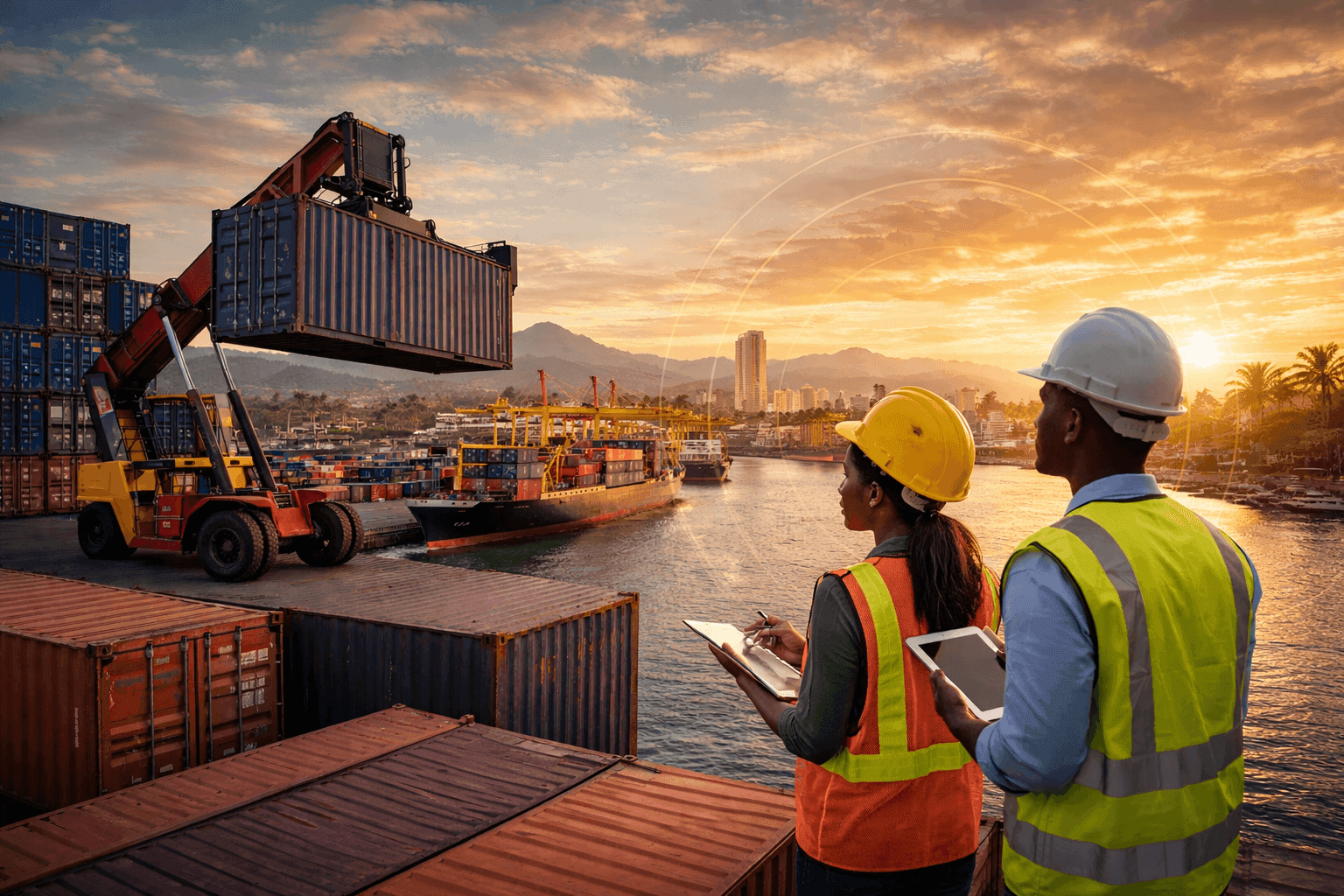
The Tanger-Med port, one of the largest in the Mediterranean and Africa, reflects Morocco’s infrastructure leap. Over the past two decades, Morocco has poured resources into modernizing infrastructure, expanding industry, and enacting social reforms. The country now boasts an extensive network of highways and Africa’s first high-speed rail line, linking its major cities.
World-class ports and free zones have turned Morocco into a regional trade hub – the Tanger-Med port alone handles millions of containers and vehicles annually, making it the biggest in Africa. This infrastructure push has gone hand-in-hand with industrial growth. Morocco’s automotive sector, for instance, has evolved into the continent’s largest: major firms like Renault and Stellantis produce cars in Morocco, helping drive annual vehicle production above half a million units and automotive exports over $14 billion. Such developments have fueled economic diversification and job creation. Indeed, Morocco has seen “significant economic and development progress” in recent years, with improved living standards and wider access to services noted across the population.
Social indicators have also advanced. Health outcomes, for example, have improved thanks to expanded healthcare infrastructure and programs. Life expectancy, now in the mid-70s, has risen steadily as Morocco tackled diseases and improved rural health access. These tangible gains, however, unfold gradually and often fail to move the needle of an index that averages decades of human development. To better illustrate Morocco’s ongoing progress, consider a few recent initiatives and achievements:
Social Protection Reforms: The government launched an ambitious reform to widen the social safety net, including universal health insurance coverage and expanded family allowances for the vulnerable. A new direct cash transfer program was rolled out in 2023 to support low-income households, signaling a push to strengthen human capital and reduce poverty. (As of 2022, Morocco’s national poverty rate had fallen to around 3.8%.) These efforts aim to improve quality of life beyond what GDP figures alone reveal.
Women’s Inclusion: Policymakers have increasingly emphasized gender inclusion as vital for development. Reforms in family law, girls’ education, and labor policy are gradually chipping away at barriers. Leaders have stressed the importance of women’s equality and participation in society, and programs now encourage women’s entrepreneurship and workforce skills. While Morocco still has a low female labor participation rate (a legacy reflected in lower household incomes and education levels for women), the focus on empowering women represents a social shift not captured directly by the HDI.
Industrial Growth: Beyond automobiles, Morocco has become a manufacturing and export powerhouse in areas like aerospace, textiles, and fertilizers. The government’s industrial acceleration plans and investment incentives have paid off in rising output. Morocco is now Africa’s leading car producer and exporter, surpassing even South Africa in recent years. The automotive sector alone has created tens of thousands of jobs and attracted a network of over 250 suppliers. Such industrial modernization drives up incomes and skill levels, yet its impact on the HDI is mostly indirect (through slowly higher GNI per capita and future educational improvements).
Renewable Energy Revolution: Morocco has earned recognition as a renewable energy pioneer in the region. Thanks to massive projects like the Noor Ouarzazate solar complex – the world’s largest concentrated solar power plant at 510 MW – and numerous wind farms, Morocco has already reached nearly 38% renewable electricity capacity by 2023.
The Noor solar farm alone stretches over 3,000 hectares of desert and can power a million homes. This green energy boom bolsters long-term sustainable development and energy security. However, the HDI’s formula does not factor in environmental progress or infrastructure quality, meaning these forward-looking investments won’t show up in Morocco’s HDI score (except insofar as cheaper energy and new jobs eventually reflect in income and health metrics).
Despite these strides, why hasn’t Morocco’s HDI climbed faster? The core reason is that human development indicators improve at an inherently gradual pace – especially education and literacy, where Morocco started from a low base. Large segments of the adult population received little formal schooling in decades past, and it takes a generation or more for educational attainments to substantially rise in the national average. For example, adult literacy in Morocco remains around 77%, meaning nearly a quarter of adults cannot read and write proficiently. This is a dramatic improvement from a few decades ago (literacy was barely above 50% in the 1990s), but such transformations occur over many years. Until more of Morocco’s workforce is made up of well-educated younger generations, the mean years of schooling (currently just 6.2 years) will inch upward slowly. Similarly, health gains accrue over time – a child born today enjoys far better nutrition and healthcare than her grandparents did, but the statistical effect on life expectancy unfolds as that healthier generation ages. In short, Morocco is experiencing rapid but uneven development: cutting-edge infrastructure and booming industries coexist with pockets of low literacy and poverty. The HDI, by design, averages out these divergences, so it lags behind the country’s current trajectory.
A Useful but Limited Measure
Morocco’s experience highlights both the value and the limitations of the HDI. On one hand, the index provides a long-term perspective that rightly flags enduring gaps in education and income – areas Morocco must continue to improve. On the other hand, the HDI is “a simplification and only captures part of what human development entails”. It cannot fully account for qualitative changes like better infrastructure, social cohesion, security, or political inclusion. Nor does it reflect inequalities within the country. A nation can therefore make enormous progress in concrete terms and still move only marginally in the rankings. As the UN Development Programme itself cautions, the HDI doesn’t capture aspects like inequality, empowerment or regional disparities – factors that can shape people’s lived experience of development.
For Morocco, the HDI’s narrow lens understates the pace and depth of change. The country’s investments in highways, ports, factories, hospitals, schools, and clean energy are laying the groundwork for future human development leaps, even if the statistical payoff in the HDI will take time to materialize. In many ways, Morocco today is more developed than its rank implies, though that does not diminish the real challenges it faces in lifting up its lagging indicators. The lesson is that while indices like the HDI are useful for broad international comparisons, they are not infallible barometers of on-the-ground progress. Development is a multidimensional, generational journey – one that countries like Morocco navigate in ways that a single number, however well-crafted, can only partially capture.